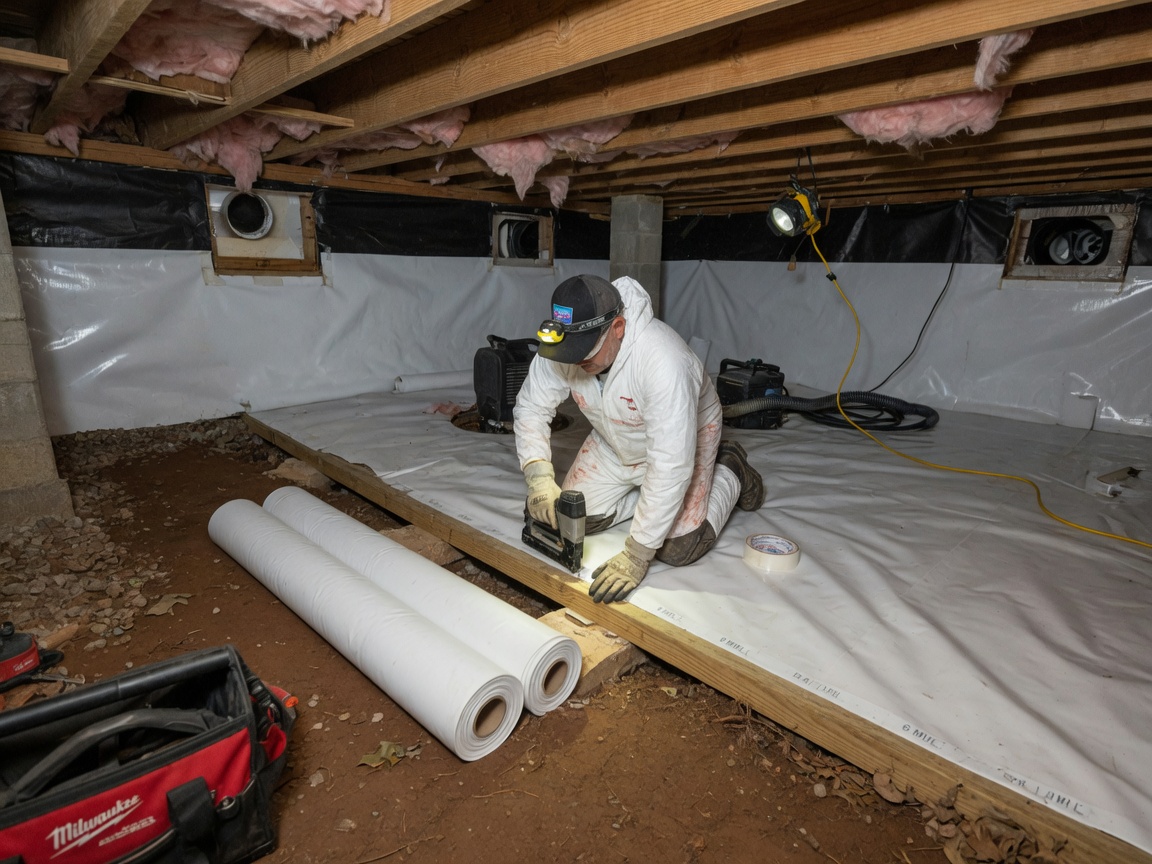
Tulsa homes built before 1970 in neighborhoods like Maple Ridge and Greenwood often sit on pier-and-beam foundations with dirt floors that pull moisture from the soil during warm humid summers. Encapsulation starts with a heavy-duty vapor barrier sealed to the foundation walls and piers, then ties into a dehumidifier sized for the square footage. Without this seal, cold winter air mixes with ground moisture and creates condensation that rots joists and feeds mold growth under kitchens and bathrooms.
Severe thunderstorms common in Tulsa County push water through vents and low-grade yards in Brookside and Utica Square. We install French drains inside the crawl space that tie to exterior sump pumps when grading allows, and we always check for radon pipes before closing the system. Older homes near the Pearl District frequently have cast-iron plumbing that leaks onto the soil; we isolate those lines with separate barriers so any future drip does not compromise the new liner.
Access in narrow crawls under Bixby and Owasso ranch houses requires cutting entry doors through brick or siding when none exist. We use 20-mil reinforced poly that resists punctures from sharp limestone fragments common in local soil. Every seam receives mechanical fasteners plus mastic so the barrier stays intact when technicians move through the space for future HVAC work.
After encapsulation we run a continuous exhaust line from the dehumidifier to the exterior so moist air does not re-enter living spaces above. This step matters most in Cherry Street bungalows where the crawl sits directly under bedrooms and the added humidity load shows up as musty smells in closets.
Technician insight
In Tulsa the thing that catches most people out with Crawl Space Encapsulation is how quickly warm humid air from July storms condenses on cold ductwork once the vents are sealed. Old pier-and-beam homes in Cherry Street and Greenwood often have no existing access doors, so we cut new ones through brick before we can even start the liner. Skipping the rim-joist seal lets winter air leak straight up into the floors above.
Brookside Bungalow After Spring Storms
Water had pooled under the kitchen after repeated thunderstorms. We found saturated soil against the east foundation wall and active leaks at two cast-iron joints. After installing an interior drain and sump, we encapsulated the entire 920-square-foot crawl with a sealed 20-mil liner and added a dehumidifier. The homeowner reported dry floors and no more musty smell within two weeks.
Crawl Space Encapsulation Services We Offer
✓Vapor Barrier Installation
Heavy 20-mil reinforced liner sealed to walls and piers prevents ground moisture from entering Tulsa crawl spaces year-round.
✓Crawl Space Dehumidifier Setup
Whole-space units sized for local humidity loads keep relative humidity under 55 percent even during July thunderstorms.
✓Interior French Drain and Sump Pump
Perimeter drains collect storm water that enters through vents or low spots common in Jenks and Bixby lots.
✓Insulation and Rim Joist Sealing
Closed-cell spray foam on rim joists stops cold winter air infiltration in older Tulsa County homes.
✓Radon Mitigation Integration
Passive or active venting installed during encapsulation to meet Tulsa County soil-gas requirements.
Crawl Space Encapsulation Cost in Oklahoma
| Service | Typical Range | What Affects It |
|---|---|---|
| Basic Encapsulation Under 1,000 sq ft | $2,800–$4,200 | Single dehumidifier, no drainage; price rises with difficult access in older Maple Ridge homes. |
| Full Encapsulation With Drainage | $4,500–$7,500 | Includes French drain and sump pump for lots in Jenks or Bixby that see frequent storm water. |
| Dehumidifier Upgrade | $900–$1,600 | Larger unit needed for homes near the Gathering Place with high summer humidity loads. |
Ranges are typical for Oklahoma and confirmed with an exact written quote before any work starts.
How it works
- 1
Site Evaluation
We measure the crawl, note access points, check for standing water, and test soil moisture in neighborhoods like Greenwood or Downtown Tulsa.
- 2
Moisture Control Prep
Any active leaks are isolated and French drains or sump pumps are installed before the liner goes down.
- 3
Barrier Installation
The 20-mil liner is rolled out, sealed at every seam, and mechanically fastened to foundation walls and piers.
- 4
Equipment And Sealing
Dehumidifier, exhaust ducting, and rim-joist insulation are added, then the system is tested for airflow and humidity control.
Pricing
Upfront quotes based on square footage, access difficulty, and any added drainage work required by local soil and storm patterns.